Different medium, different story form. It’s clear that each new technology — photography, radio, television — has brought with it different ways of constructing a narrative, and different ways those narratives fit into the audience’s lives. Online media are no different, and the step between analog and digital is in many ways much larger than any that has come before, because the internet connects the audience to each other as well as to the newsroom.
Here’s my attempt at a little reading list of recent work on the structure of stories. Pointers to additional material are welcome!
The Big Picture
What’s wrong with the article, anyway? Jeff Jarvis explores this question in “The article as luxury or by-product.” This essay provoked lots of interesting reaction, such as from Mathew Ingram.
So how do we understand ways to fix this? Vadim Lavrusik takes a shot at this question and comes up with the building blocks of context, social, personalization, mobile, participation. It’s a good taxonomy so I’m going to partially steal it for this post.
At the NYC Hacks Hackers meetup last week, Trei Brundrett took us through SB Nation’s “story stream” product, and Gideon Lichfield of The Economist gave a really nice run through of the “news thing” concept that was fleshed-out collaboratively last month at Spark Camp by Gideon, Matt Thompson, and a room full of others. Very meaty, detailed, up-to-the-minute discussions, for serious news nerds. Video here.
Context
You just can’t do better than Matt Thompson’s “An antidote for web overload.” I also recommend Matt’s wonderful “The three key parts of news stories that are usually missing.” Another good primer is Jay Rosen’s “Future of Context” talk at SXSW.
See also my “Short doesn’t mean shallow,” about hyperlinks as a contextual storytelling form.
For an example of these ideas in action, consider Mother Jone’s Egypt Explainer page — which Gideon Lichfield critiques in the video linked above.
Social
What does it mean for news to be social anyway? Henry Jenkins argues for the power of “spreadable media” as a new distribution model.
In “What’s the point of social news?” I discuss two areas where social media have a huge impact on news: the use of social networks as a personalized filter, and distributed sourcing of tips and material.
Personalization
News is now personalized by a variety of filters, both social and algorithmic. Eli Pariser argues this puts us in a “filter bubble.” He may be right, but research by Pew and others [1,2] consistently shows that when users are allowed to recommend any URL to one other, the “news agenda” that the audience constructs has only 5%-30% of stories in common with mainstream media.
A comparison of questions asked of the White House by a Twitter audience vs. by journalists shows a remarkable difference in focus. All of this this suggests to me that whatever else is happening, personalization meets an audience need that traditional broadcast journalism does not.
Besides, maybe not every person needs to see every story, if we view the goal of journalism as empowerment.
Participation
What do we know and what don’t we know about public participation in the journalism project, and what has worked or failed so far? Jay Rosen has an invaluable summary.
I also recommend the work of Amanda Michel as someone who does crowd-based reporting every day, and my own speculations on distributed investigative reporting.
Structured information
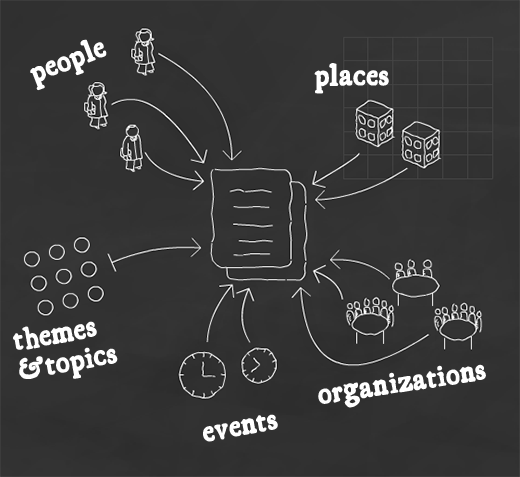
Is the product of journalism narratives or (potentially machine-readable) facts? Adrian Holovaty seems to be the first to have explored this in his 2006 essay “A fundamental way newspaper websites need to change.” This mantle has been more recently taken up by Stijn Debrouwere in his “Information Architecture for News Websites” series, and in Reg Chua’s “structured journalism,” and in a wide-ranging series at Xark.
There are close connections here to semantic web efforts, and occasional overlap between the semweb and journalism communities.
Mobile
I haven’t seen any truly good roundup posts on what mobile will mean for news story form, but there are some bits and pieces. Mobile is by-definition location aware, and Mathew Ingram examines how location is well used by Google News (and not by newsrooms.)
Meanwhile, Zach Seward of the Wall Street Journal has done some interesting news-related things with Foursquare.
Real time
Emily Bell, formerly of the Guardian and now at Columbia, explains why every news organization needs to be real-time.
For a granular look at how informations spreads in real time, consider Mathew Ingram on “Osama bin Laden and the new ecosystem of news.” For a case study of real-time mobile reporting, we have Brian Stelter’s “What I learned in Joplin.”